If your dog pulls hard, slips out of the harness, or turns every walk into a mess of straps and tangles, you don’t need “more willpower.” You need a simple system: measure correctly, fit the gear correctly, use the right leash setup, and follow one clear training rule every time.
This guide uses Dog Friendly Co as a reference because their sizing notes, no-pull explanation, and leash details stay clear. You can apply the same steps to any brand.
The 3 real problems most people face
1) Pulling (and sore hands/shoulders)
Your dog pulls because pulling works: pulling = moving forward.
You fix this by changing:
- the mechanics (your gear setup), and
- the outcome (your training rule).
2) Bad harness fit (rubbing, twisting, “it doesn’t work”)
Most harness complaints come from fit mistakes:
- straps sit too close to the armpits,
- the harness sits too far forward,
- you guess the chest size instead of measuring it.
3) Walk chaos (two dogs, distractions, sudden lunges)
This usually happens because your setup and routine don’t match the situation:
- leash is the wrong length,
- you don’t use a short “control grip” (traffic handle behavior),
- you don’t follow a predictable stop/turn rule.
No-pull harness: how it works (and when to use it)
A no-pull harness uses a front attachment point. When your dog pulls, the leash pressure turns your dog back toward you instead of letting them drive straight forward.
That turn matters because it breaks the pattern: pull forward = move forward.
Use a no-pull setup when:
- your dog pulls hard at the start of walks
- your dog lunges at triggers (dogs, people, bikes)
- you walk in crowded places and need more steering
- you actively train loose-leash walking
Front D-ring attachment: an easy upgrade for pullers
If you already own a harness but you want more no-pull control, add a front D-ring attachment. It creates a front clip point.
Dog Friendly Co describes their front D-ring attachment as something that:
- converts their harness into a no-pull setup
- gives you more control when your dog pulls
- helps guide your dog back to your side
- supports training walk behavior
Think of it like a “gear lever” that reduces how much strength you need while you train.
Where to measure for a dog harness (don’t skip this)
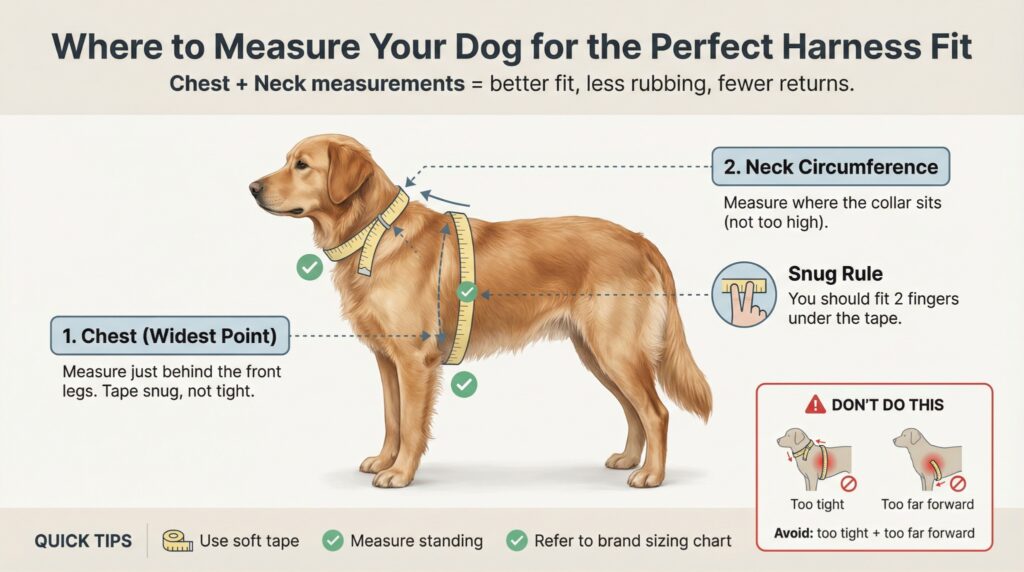
If you want fewer returns, less rubbing, and better control, you must measure. Don’t guess.
Measure like this:
- Measure the chest at the widest point, usually just behind the front legs.
- Keep the tape snug, not tight.
- Measure the neck circumference too.
Between sizes? Use the narrow vs wide rule
Dog Friendly Co’s sizing logic is practical:
- If your dog looks narrow, choose the smaller size.
- If your dog looks wide/broad, choose the larger size.
- Leave about 1–2 cm for comfort.
This solves the classic problem: “I bought the right brand, but it rubs/slips/twists.”
The 60-second fit check (stops rubbing and prevents escapes)
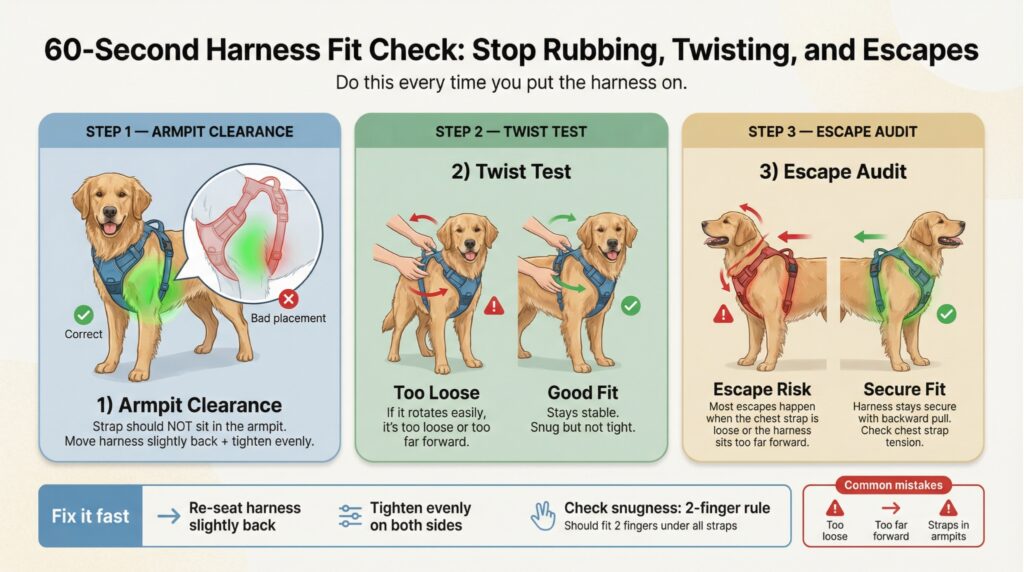
Use this quick checklist every time you put the harness on.
1) Armpit clearance (fix rubbing)
If the straps sit in the armpit area, your dog will likely rub.
- Move the harness slightly back
- Tighten straps evenly
- If you sit between sizes, use the narrow/wide rule
2) Twist test (fix wobble)
Gently twist the harness.
- If it rotates easily, the harness sits too loose or too far forward.
3) Escape audit (stop backing out)
Dogs slip out most often when:
- the chest strap stays too loose
- the harness sits too far forward
- the size is slightly off
Re-check your chest measurement behind the front legs, then adjust from there.
Bungee leash: what it does (and what it doesn’t)
A bungee leash won’t train your dog for you. It changes the physics of sudden pulls.
Dog Friendly Co explains their bungee leash like this:
- it stretches and absorbs shock during sudden pulls or direction changes
- it reduces strain on both you and your dog
- it adds gentle resistance and reduces the “jolt” feeling
Best for:
- strong dogs who hit you with sudden jerks
- dogs that lunge without warning
- people dealing with hand/shoulder strain while training
It will NOT:
- stop pulling long-term without training
- If your dog still learns “pulling gets me forward,” your dog will keep pulling.
The one training rule that fixes pulling
Use gear to manage the walk. Use training to solve the pulling.
The rule
Tight leash = stop. Loose leash = go.
Why it works
Dogs repeat what gets results. This rule makes pulling stop working.
A simple 7-day plan (short sessions, fast progress)
Days 1–2: low distraction (inside / driveway)
- Put on harness + leash
- Reward when your dog stands at your side
- Walk 3–5 steps
- If the leash tightens: stop and wait
- When the leash loosens: reward and continue
Days 3–4: short outdoor loops (5–10 minutes)
- Keep walks short
- Add random turns (left/right)
- Reward your dog for following without leash tension
Days 5–7: real walks with structure
- Do 2 minutes of “training mode” (more treats, more focus)
- Give a 1-minute sniff break as a reward
- Repeat the cycle
This structure fixes the common issue: “My dog behaves inside but pulls outside.”
Two-dog walking problems (tangles and opposite pulling)
When you walk two dogs, leash management usually causes the mess more than behavior does.
Quick fixes
- Keep the calmer dog closest to you
- Start with short training loops (don’t do long “endurance” walks yet)
- Practice stop-and-go plus turns in an open area first
A leash splitter can reduce tangling, but you still need the tight/loose rule so both dogs learn the same system.
Care tips: how to wash and maintain your gear
To keep straps and stitching strong (and keep sizing consistent):
- hand wash in cold water
- avoid harsh drying or high heat
- if your harness has a Velcro label, remove it before washing and wipe it separately
Returns and “risk-free” buying (what people worry about)
Most people hesitate because they fear buying the wrong size.
Dog Friendly Co’s returns info mentions:
- you can start a return or exchange
- refunds can take 7–10 business days to show up (depends on the bank/payment provider)
- their site also mentions risk-free trial, lifetime warranty, and free returns/exchange messaging (always verify terms at checkout)
Before you buy
- measure the chest properly (behind front legs)
- if you’re between sizes, use the narrow/wide rule + 1–2 cm comfort space
- avoid personalization until you confirm sizing (many stores limit returns on personalized items check the policy)
Want to buy the gear?
If you’re ready to purchase the harness, front D-ring attachment, or bungee leash, it’s best to buy directly from the official store so you get the correct product details, sizing guidance, and the most accurate return/exchange terms.
Shop the official store here: (dogfriendlyco)
How to find a Dog Friendly Co discount code without wasting time
People search “Dog Friendly Co coupon code / promo code / discount” all the time, but many random codes don’t work.
Do this instead:
- check the site at checkout for active promos
- look for bundle deals if you buy multiple items
- subscribe to promotional emails if they offer them
FAQ
How does a no-pull harness work?
It uses a front attachment point. When your dog pulls, the leash redirects your dog back toward you instead of letting them drive forward.
Where do I measure my dog for a harness?
Measure the widest part of the chest (usually behind the front legs). Then measure the neck.
What if my dog is between harness sizes?
Choose smaller for narrow builds, larger for wide builds, and leave 1–2 cm for comfort.
Do bungee leashes stop pulling?
They reduce the shock and make pulling feel less harsh, but they don’t replace training.
What is a front D-ring attachment used for?
It adds a front clip point so you can create a no-pull setup and guide your dog better during training walks.