


Hume Body Pod looks consistent enough to be useful for body-composition estimates, but I would not treat one body-fat reading as your exact number.
Independent testing found strong short-term repeatability, but Hume’s body-fat percentage could still differ from DXA.[1]
You’re dieting, lifting, or trying hard to lose fat then Hume suddenly gives you a body-fat number you were not expecting.
Now the real problem isn’t the number. It’s wondering: “Is my progress actually real, or is Hume wrong?”
Hume says hydration, food, exercise, alcohol, and measurement timing can affect BIA estimates.[2]
So before you trust the reading or give up on the Pod here’s what to check first.
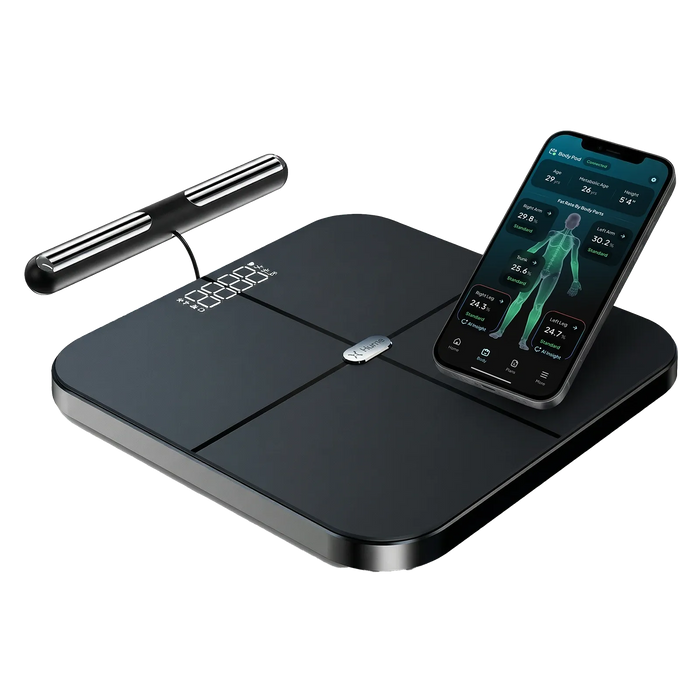
Hume Body Pod
$22945-day trial · Free shippingNo required subscriptionShop Hume Body Pod
Why is my Hume body-fat reading changing?
A sudden change does not automatically mean you gained or lost that much fat.
Hume uses bioelectrical impedance analysis, or BIA. Hydration, food, recent exercise, alcohol, and measurement timing can affect the estimate.[2]
First question: did you measure under similar conditions?
What should I check before blaming the Hume Pod?
Give the device a fair test before judging one strange result.
These checks match Hume’s own measurement guidance.[2]
What does independent research actually say?
Simple answer: Hume was very consistent when the same people were tested repeatedly but it did not always match DXA.[1]
A July 2026 independent preprint tested the Hume Pod in 67 adults against DXA and a four-compartment body-composition model.
The Pod showed excellent short-term repeatability.[1]
Against DXA, the average absolute body-fat difference was around 3 percentage points, and Hume’s body-fat percentage was not statistically equivalent to DXA.[1]
Want the technical numbers?
The study reported ICC values of at least 0.993 and a technical error of about 0.8 percentage points for body-fat percentage.[1]
The study measured short-term repeatability. It did not prove that Hume perfectly tracks true fat loss over several months.
Best way to think about it: Hume gives you an estimate, not a lab result.
Do real Hume users get close to DEXA?
Sometimes very close. Sometimes not even close.
Don’t use one Reddit post to decide whether Hume is accurate or inaccurate.
These are individual experiences, not scientific proof. They simply show that results can vary from person to person.
Can Hume tell if I’m losing fat instead of muscle?
It gives you more information than a normal weight scale but the numbers are still estimates.
Your total weight cannot tell you whether a change came from fat, muscle, or water.
Hume estimates body fat, muscle mass, visceral fat, body water, and other body-composition metrics.[6]
That may be useful if you’re trying to lose fat, lifting weights, doing body recomposition, or worried about losing muscle while losing weight.
Just remember: a change inside the app does not prove your body changed by exactly that amount.
Hume Body Pod
$229Best fit: people who want more context around fat and muscle than a normal scale can give them.
- 45-day at-home trial
- Free shipping
- No required subscription for core Pod data
- 45+ estimated body-composition metrics
Should I trust one Hume reading?
No. One unusual reading should not decide whether your progress is good or bad.
Hume currently positions the Pod for tracking estimated body-composition trends rather than as a replacement for a clinical measurement such as DXA.[6]
Compare the reading with other signs of progress:
- body weight
- waist measurement
- how your clothes fit
- progress photos
- gym strength
If several signals move in the same direction, you have more context than one body-fat number alone can give you.
What if Hume and DEXA are very different?
Don’t automatically assume the Hume number is right.
First repeat your Hume measurements under more consistent conditions.
Check hydration, timing, exercise, surface, and profile settings.[2]
If the gap stays large, remember that Hume’s body-composition readings are estimates rather than clinical measurements.[6]
So, is Hume Body Pod worth trusting?
Yes if you understand what you’re trusting it to do.
Independent research supports Hume as a highly repeatable consumer device under controlled conditions.[1]
What the evidence does not prove is that every body-fat reading is exact or that your result will always match DXA.
If your main frustration is:
“My normal scale only tells me my weight. I want more context around fat and muscle.”
then Hume may give you useful extra information.
Keep it simple
- Measure under similar conditions.
- Don’t panic over one strange reading.
- Watch the bigger pattern.
- Compare Hume with other signs of progress.
- Use a stronger test when exact numbers matter.
Bottom line: use Hume’s body-fat number as an estimate not as the final judge of whether your progress is real.
You’ve seen where Hume performs well, where its readings have limits, and who the Pod makes the most sense for.
Sources & references
- [1] Tinsley GM, et al. Validity and Test-Retest Reliability of the Hume Pod Bioimpedance Analyzer for Body Composition Assessment. Open source ↗
- [2] Hume Health FAQ / measurement guidance. Open source ↗
- [3] Reddit / r/HumeHealth Another Hume/DEXA Comparison. Open source ↗
- [4] Reddit / r/HumeHealth Body Fat Reading vs DEXA. Open source ↗
- [5] Reddit / r/HumeHealth Hume BodyPod vs DEXA Result. Open source ↗
- [6] Hume Health The Hume Pod. Open source ↗
Independent research, manufacturer statements, and individual Reddit experiences are intentionally separated. Reddit examples are anecdotal and are not treated as scientific proof.
 ✓
✓