
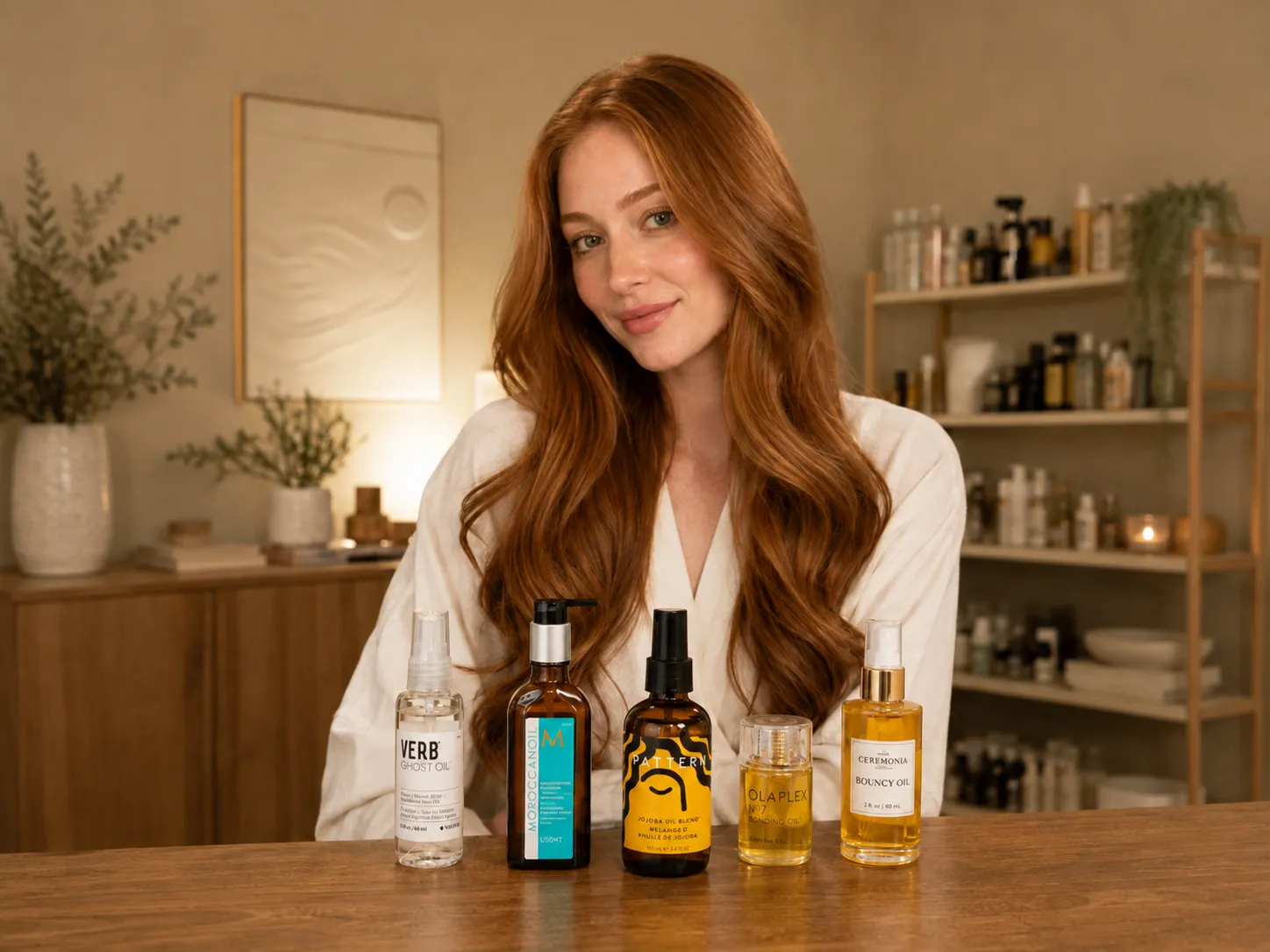

If your fine, low-porosity hair becomes flat or greasy after oil, choose a lightweight finishing formula and use it mainly where your hair actually feels dry.
Verb Ghost Oil is the easiest option here to compare for fine straight or wavy hair. PATTERN Jojoba Oil Blend is more relevant for low-porosity curls and coils. OLAPLEX No.7 is worth comparing if heat styling is part of your routine, while Curlsmith Bonding Oil is more curl-focused.
Most products in this guide are formulated cosmetic finishing oils rather than bottles of one pure plant oil. The complete formula and the amount you apply usually matter more than one ingredient on the front label.
Which hair oil should you choose for fine, low-porosity hair?
Choose based on your texture and main problem, not simply the word “low porosity.” A product that works well as a curl-finishing oil may not be the most practical choice for very fine straight hair.
| Product | Best fit | Formula style | Fragrance | When to use | Value context | Main drawback |
|---|---|---|---|---|---|---|
| Verb Ghost Oil | Fine straight or wavy hair | Formulated finishing oil with silicones and plant oils | Fragranced | Damp or dry hair | Mid-range; standard bottle is larger than OLAPLEX No.7 | Not specifically made around low porosity |
| Moroccanoil Treatment Light | Fine or light-colored hair | Silicone-based treatment with argan oil | Fragranced | Towel-dried or dry hair | Multiple sizes make trial easier | Not a minimalist oil formula |
| PATTERN Jojoba Oil Blend | Low-porosity curls and coils | Multi-plant-oil blend | Contains scented ingredients | Wet or dry hair | Larger bottle than most products here | May feel excessive on very fine straight hair |
| OLAPLEX No.7 Bonding Oil | Heat-styled or frizz-prone hair | Concentrated styling oil | Fragranced | Wet, damp or dry hair | Smaller bottle; intended for small applications | Low porosity is not its main focus |
| Curlsmith Bonding Oil | Fine waves and curls | Silicone-free finishing formula with esters and oils | Fragranced | Fully dry hair | Mid-range bottle size | Less relevant for straight hair |
Product formula, use and hair-type information is based on current manufacturer product pages. Amazon pricing can change, so live dollar prices are not used as ranking factors.
Does fine, low-porosity hair actually need hair oil?
No. Low porosity does not automatically mean your hair needs oil. If your hair already feels soft, flexible and manageable, adding another finishing product may only make it heavier.
Hair porosity can vary between individual fibers and along the same strand. Simple home tests such as the float test also have limitations, so it is more useful to pay attention to how your hair reacts to products. [1]
Is Verb Ghost Oil a good option if fine hair gets weighed down easily?
Verb Ghost Oil
It is one of the more straightforward products here to compare if your main problems are frizz, flyaways and a heavy finish from richer oils. Verb currently positions Ghost Oil for fine-to-medium hair. [4]
This is a formulated finishing product rather than a pure moringa or argan oil. That can be useful if you want a smoother cosmetic finish, but it is not the right choice if you deliberately avoid silicones or fragrance.
- Your fine hair needs light finishing rather than heavy oiling.
- Frizz and flyaways are your main problems.
- You avoid silicones or fragrance.
- You want a product specifically aimed at low-porosity curls.
Should you choose Moroccanoil Treatment Light instead of the original?
Moroccanoil Treatment Light
The Light version is the more relevant Moroccanoil option if your hair is fine and becomes heavy easily. Moroccanoil currently identifies it for fine or light-colored hair. [5]
Its current formula contains silicones as major ingredients, so it should be viewed as a smoothing treatment containing argan oil rather than pure argan oil. Smaller bottle sizes may be useful if you have not tried the formula before.
- You want smoothing without choosing the richer original version.
- Your hair is fine or light-colored.
- You want silicone-free or fragrance-free hair care.
- You mainly need a curl-focused product.
Is PATTERN Jojoba Oil Blend a better match for low-porosity curls?
PATTERN Jojoba Oil Blend
It is the most directly low-porosity-focused option in this shortlist for curly and coily hair. PATTERN currently includes low-porosity hair in the product’s intended use. [6]
The formula includes jojoba and several other plant oils. That makes it more relevant to curls and coils than someone with extremely fine straight hair who only wants a tiny amount of finishing product.
- Your hair is low porosity and curly or coily.
- You prefer an oil-blend format.
- Your straight fine hair gets greasy extremely easily.
- You are sensitive to scented products.
Should you consider OLAPLEX No.7 if you regularly use heat tools?
OLAPLEX No.7 Bonding Oil
It is the most relevant product here if heat styling is a major part of your routine. OLAPLEX positions No.7 as a concentrated styling oil for use on wet, damp or dry hair. [7]
The bottle is smaller than several alternatives in this guide, so compare the current price and how little product you expect to use before judging value. Low porosity itself is not the product’s main focus.
- You frequently blow-dry, straighten or curl your hair.
- Frizz is a bigger concern than using a pure oil.
- You want a simple plant-oil blend.
- You rarely use heat tools.
Is Curlsmith Bonding Oil a better fit for fine curls and waves?
Curlsmith Bonding Oil
It is the most curl-focused finishing option in this group. Curlsmith currently recommends it as a finishing product for wavy, curly and coily hair. [8]
This makes more sense for smoothing finished curls or softening a styling-product cast than for someone looking for an oil to apply before blow-drying straight hair.
- You have fine waves or curls.
- You want a silicone-free finishing product.
- Your hair is straight.
- You need fragrance-free hair care.
What should you do if your roots are oily but your ends are dry?
Apply oil mainly where the dryness is instead of automatically coating your scalp and roots.
- Start at the driest ends.
- Use the smallest practical amount.
- Spread the product across your palms before applying it.
- Avoid layering several rich leave-ins plus oil unless your hair actually needs them.
- Keep oil away from already-greasy roots unless the product is specifically being used there for another reason.
What should you choose if humidity and frizz are your main problems?
Compare Verb Ghost Oil or OLAPLEX No.7 first. Both are positioned as styling/finishing products rather than simple raw oils, making them more relevant when frizz control is the main purchase reason.
What should you do if a lightweight oil still causes buildup?
Reduce product layering before buying another oil. Fine hair can feel coated when several leave-ins, creams, serums and oils are used together—even if each product is marketed as lightweight.
- Pause or reduce the oil and see whether volume returns.
- Use less when you reintroduce it.
- Apply only to areas that actually feel dry.
- Make sure your normal shampoo removes your styling products adequately.
- If residue persists, consider a shampoo intended for buildup removal and follow its directions rather than using a rigid clarifying schedule.
What if your fine hair is color-treated or bleached?
Choose based on your current texture and styling routine rather than assuming all chemically processed hair needs a heavier oil.
Processing can make different sections of the same head behave differently. If your ends are dry but roots remain fine and oily, apply the finishing product selectively. If you regularly heat-style colored hair, a styling-focused product may be more practical than a heavy raw oil.
Why isn’t pure coconut oil ranked first?
Because stronger hair-fiber research does not automatically make an oil the easiest daily finishing product for fine hair.
Published research has found that coconut oil can penetrate hair and reduce protein loss under studied conditions. [2] [3] That evidence is useful, but it does not show that pure coconut oil is the best cosmetic finishing product for every person with fine or low-porosity hair.
Which hair oil should you actually choose?
Fine straight or wavy hair: compare Verb Ghost Oil first.
Fine or light-colored hair: compare Moroccanoil Treatment Light.
Low-porosity curls or coils: compare PATTERN Jojoba Oil Blend.
Frequent heat styling: compare OLAPLEX No.7.
Fine curls and waves: compare Curlsmith Bonding Oil.
If your hair already looks soft, shiny and manageable without oil, you may not need to add one at all.
Frequently asked questions
Is argan oil good for fine, low-porosity hair?
It can work, but the complete formula matters more than seeing argan oil on the label. Fine hair may respond differently to pure oil versus a formulated finishing treatment containing argan oil.
Is jojoba oil better than coconut oil for low-porosity hair?
There is not enough independent comparative evidence to say jojoba is universally better. Coconut oil has published hair-fiber research, while jojoba appears in many cosmetic formulas designed for lighter application.
Can lightweight hair oil still cause buildup?
Yes. A lightweight feel does not guarantee that repeated applications will suit every head of fine hair. Using too much or layering oil over several leave-ins can make hair feel coated.
Should you apply hair oil to wet or dry fine hair?
Follow the directions for the specific product. Some oils in this guide can be used on damp or dry hair, while Curlsmith Bonding Oil is intended mainly as a dry-hair finishing step.
How often should you use oil on fine, low-porosity hair?
There is no universal schedule. Reduce the amount or frequency if your hair becomes flat, coated or greasy earlier than usual.
Do hair oils actually moisturize low-porosity hair?
Oils and water do not perform the same role. Different oils can interact with the hair fiber in different ways, but oil does not replace the rest of your cleansing and conditioning routine. [3]
Ready to compare current prices?
Choose the option that best matches your hair type and styling routine, then check the current listing before buying.
Sources & references (8)
- New York Society of Cosmetic Chemists — An Overview on Hair Porosity Open source ↗
- Rele AS, Mohile RB — Effect of mineral oil, sunflower oil and coconut oil on prevention of hair damage Open source ↗
- Sureka P, et al. — A Method to Measure Oil Penetration into Hair Open source ↗
- Verb — Ghost Oil Open source ↗
- Moroccanoil — Treatment Light Open source ↗
- PATTERN Beauty — Jojoba Oil Blend Open source ↗
- OLAPLEX — No.7 Bonding Oil Open source ↗
- Curlsmith — Bonding Oil Open source ↗
 ✓
✓