HNY+ or RONE: which should you actually choose?
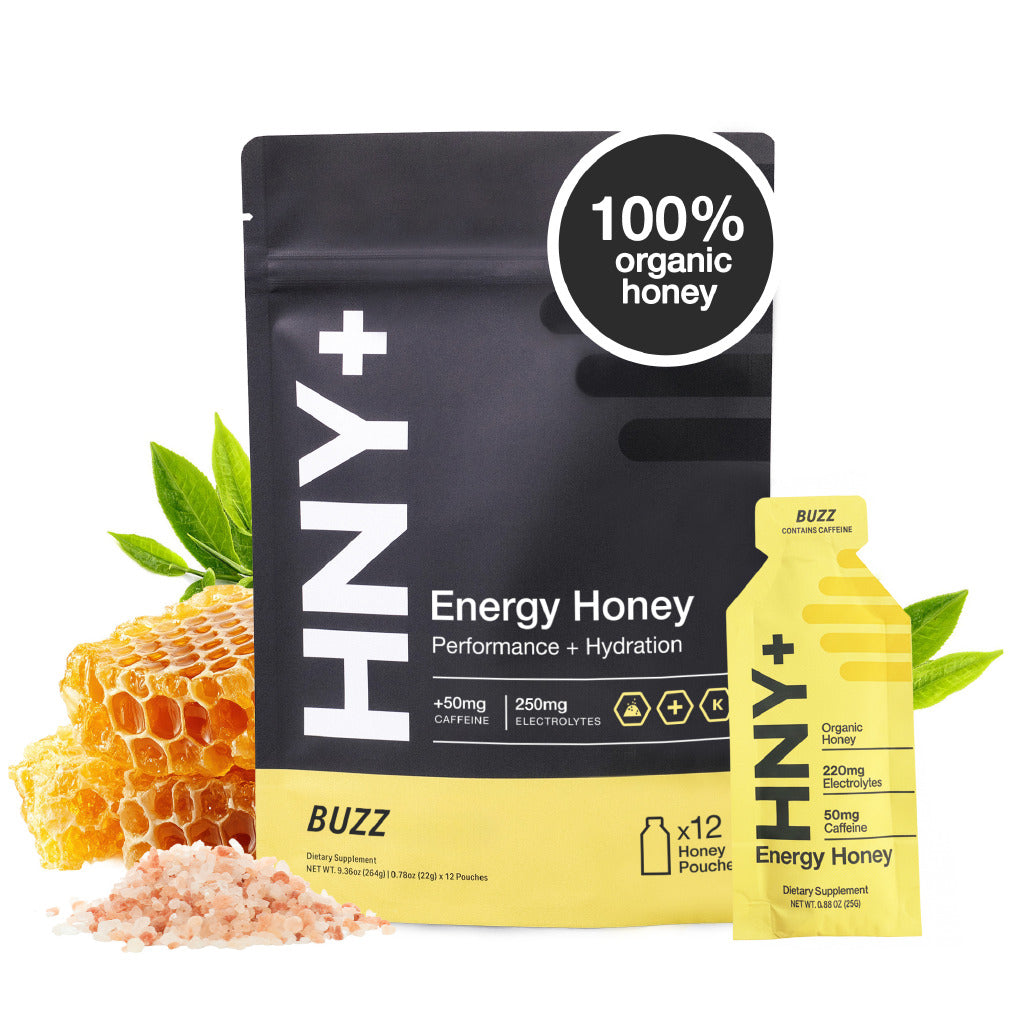
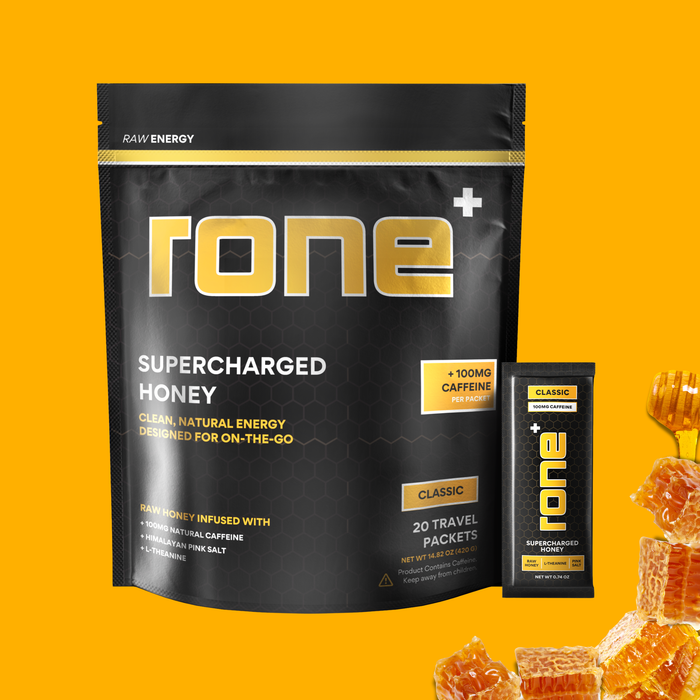
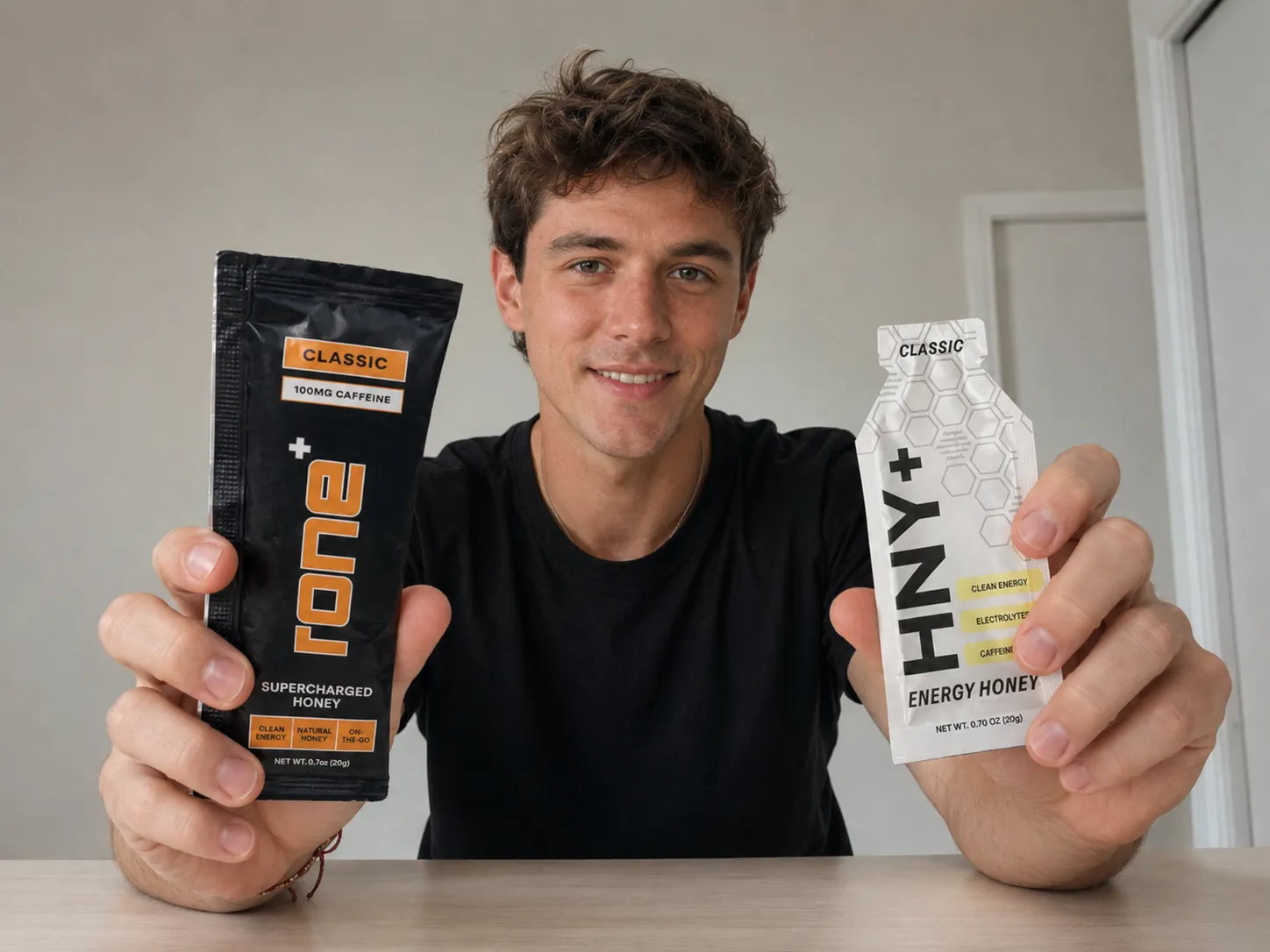
HNY+ is the more flexible choice if you want caffeine-free or lower-caffeine honey fuel, while RONE Classic 100 makes more sense if you specifically want 100 mg of caffeine in one packet. HNY+ Classic is caffeine-free and Buzz contains 50 mg caffeine. RONE Classic 100 lists 100 mg caffeine and 17 g carbohydrate per packet. [1] [2]
In this article, “RONE” mainly refers to RONE Classic 100 unless another version is specifically mentioned. RONE also sells other caffeine strengths, so 100 mg should not be treated as the dose in every RONE product.
What are the important differences between HNY+ and RONE?
The meaningful differences are caffeine dose, carbohydrate amount, electrolyte labeling and price not marketing language about “clean” energy.
| What matters? | HNY+ | RONE Classic 100 |
|---|---|---|
| Caffeine |
Classic: 0 mg Buzz: 50 mg [1] |
100 mg [2] |
| Carbohydrate | 18 g on The Feed’s current Classic nutrition panel [3] | 17 g [2] |
| Sodium | 140 mg on the Classic retailer nutrition panel [3] | 100 mg [2] |
| Other listed electrolytes | Potassium and magnesium are also listed [3] | No directly comparable potassium or magnesium amounts are shown on the Classic 100 nutrition information reviewed |
| Main buying reason | Caffeine flexibility | Higher caffeine dose in one packet |
Which one fits your type of workout or run?
Session length matters more than simply calling one product the “running winner” and the other the “gym winner.”
What about a 45–60 minute gym session?
You may not need a honey packet at all if normal food already covers your needs. If your reason for buying is caffeine, HNY+ Buzz provides 50 mg while RONE Classic 100 provides 100 mg. [1] [2]
Choose the dose you actually want and tolerate rather than assuming a harder workout automatically requires more caffeine.
What about a 90–150 minute run?
HNY+ may be easier to work into a longer session because you can use caffeine-free Classic or the 50 mg Buzz version.
That does not make HNY+ a complete fueling plan. Total carbohydrate, fluids, sodium, food, other gels and total caffeine still matter.
Can either packet cover your whole race-fueling plan?
Usually not by itself. Each packet contributes only about 17–18 g of carbohydrate based on the current labels reviewed. [3] [2]
Sports-nutrition guidance commonly discusses carbohydrate intake around 30–60 g per hour during prolonged exercise, although individual needs vary. [4]
Should you first try these on race day?
No. Test the exact packet, sweetness, caffeine dose and how it fits with your existing food and fluid routine during training first.
How much caffeine does each packet give you?
HNY+ Classic has 0 mg, HNY+ Buzz has 50 mg, and RONE Classic 100 has 100 mg caffeine per packet. [1] [2]
| Number of packets | HNY+ Buzz | RONE Classic 100 |
|---|---|---|
| 1 | 50 mg | 100 mg |
| 2 | 100 mg | 200 mg |
| 3 | 150 mg | 300 mg |
The FDA cites 400 mg per day as an amount not generally associated with negative effects for most adults, while also emphasizing that caffeine sensitivity varies widely. [5] This is a general reference, not a personal target.
How many carbs do HNY+ and RONE actually give you?
The nutrition information reviewed lists 18 g carbohydrate for HNY+ Classic and 17 g for RONE Classic 100. [3] [2]
| Packets | HNY+ at 18 g each | RONE Classic 100 at 17 g each |
|---|---|---|
| 1 | 18 g | 17 g |
| 2 | 36 g | 34 g |
| 3 | 54 g | 51 g |
For exercise lasting longer than about an hour, commonly cited sports nutrition guidance discusses roughly 30–60 g of carbohydrate per hour. [4] These are general ranges, not a personal prescription.
Which has more sodium and electrolytes?
On the labels reviewed, HNY+ Classic lists 140 mg sodium while RONE Classic 100 lists 100 mg. HNY+ also lists potassium and magnesium. [3] [2]
| Per packet | HNY+ Classic | RONE Classic 100 |
|---|---|---|
| Sodium | 140 mg | 100 mg |
| Potassium | 90 mg | Comparable amount not listed |
| Magnesium | 20 mg | Comparable amount not listed |
This tells us what is listed in each packet. It does not establish that HNY+ provides better hydration or that either packet alone covers an athlete’s electrolyte needs.
Which is cheaper and easier to buy in the U.S.?
At the listed one-time prices reviewed, RONE Classic 100 is slightly cheaper per packet than the smaller HNY+ packs, while HNY+’s larger pack brings the per-serving price closer. HNY+ offers 12-, 24- and 48-pack options, while RONE Classic 100 is sold in 20-packet bags. [1] [2]
| Option | Listed one-time price | Approx. per packet |
|---|---|---|
| HNY+ 12-pack | $32.04 | $2.67 |
| HNY+ 24-pack | $60.08 | $2.50 |
| HNY+ 48-pack | $109.03 | $2.27 |
| RONE Classic 100, 20 packets | $44.99 | $2.25 before any eligible discount |
HNY+ says it ships to all 50 U.S. states and U.S. territories. RONE’s shipping information says it currently ships within the United States. [6] [7]
Who should choose HNY+, RONE Classic 100, or neither?
HNY+ fits buyers who want more caffeine flexibility; RONE Classic 100 fits buyers deliberately looking for a 100 mg caffeine packet; neither is necessary if a simpler, cheaper carbohydrate source already works for you.
- You want caffeine-free and 50 mg options.
- You may use multiple servings during a longer session.
- You want sodium, potassium and magnesium listed.
- You prefer HNY+’s honey-based formula.
Skip it if…
- You specifically want 100 mg caffeine in one packet.
- You dislike concentrated honey.
- Your only priority is low cost per gram of carbohydrate.
- You specifically want 100 mg caffeine.
- You want 17 g carbs plus caffeine in one packet.
- You already know that caffeine and concentrated honey suit you.
Skip it if…
- You are caffeine-sensitive.
- You want several packets mainly for carbohydrate.
- You want caffeine-free fuel for most of a long session.
- Your current fueling routine already works.
- You mainly need inexpensive carbohydrate.
- You do not like honey-based fuel.
- You do not need a portable single-serve packet.
Is honey proven to be better than regular energy gels?
No. Honey can be used as a carbohydrate source, but current evidence does not establish it as universally superior to other carbohydrate sources during exercise.
A systematic review of exercise studies found broadly similar responses between honey and other carbohydrate sources in the available research. [8]
So choose HNY+ or RONE because the packet format, caffeine dose, ingredient profile and price fit your routine not because “natural honey” by itself proves better performance.
So, should you buy HNY+ or RONE?
Choose HNY+ if caffeine flexibility is the deciding factor. HNY+ Classic is caffeine-free, while Buzz provides 50 mg of caffeine. [1]
Choose RONE Classic 100 if you deliberately want a higher single-packet caffeine dose. It provides 100 mg caffeine and 17 g carbohydrate per packet. [2]
If you mainly need carbohydrate and do not care about the honey format, caffeine options or single-serve convenience, you may not need either product.
Want to check current price and availability? Use the retailer that matches each product rather than assuming both links go to the same type of store.
RONE Classic 100
Check RONE on its official store. Use code ENJOY20 for 20% off when the promotion is active.
View RONE on Official StoreThese are affiliate links, which may earn PromoLatte a commission at no extra cost to you. Prices, availability and promotions can change.
Frequently asked questions about HNY+ vs RONE
Is HNY+ better than RONE for long runs?
HNY+ may be easier to use when caffeine flexibility matters because Classic is caffeine-free and Buzz contains 50 mg. [1] That does not make HNY+ automatically better for your total carbohydrate, fluid or sodium needs.
Does RONE have more caffeine than HNY+?
RONE Classic 100 contains 100 mg caffeine. HNY+ Buzz contains 50 mg and HNY+ Classic is caffeine-free. [1] [2]
How many carbs are in HNY+ and RONE?
The nutrition information reviewed lists 18 g carbohydrate for HNY+ Classic and 17 g for RONE Classic 100. [3] [2]
Is one HNY+ or RONE packet enough for a long run?
One packet provides about 17–18 g carbohydrate. Common sports-nutrition guidance for prolonged exercise discusses roughly 30–60 g per hour, although individual needs vary. [4] One packet is therefore better viewed as one part of a fueling plan.
Which has more sodium, HNY+ or RONE?
The nutrition information reviewed lists 140 mg sodium for HNY+ Classic and 100 mg for RONE Classic 100. [3] [2] That difference alone does not establish a hydration winner.
Which is cheaper, HNY+ or RONE?
At the listed one-time prices reviewed, RONE Classic 100 is about $2.25 per packet before discounts, while HNY+ ranges from roughly $2.27 to $2.67 per serving depending on pack size. [1] [2] RONE shoppers can also try code ENJOY20 for 20% off when that promotion is active. Always compare the final checkout total.
Want one more comparison before choosing RONE?
If you are still deciding, compare RONE vs Honey Stinger for another side-by-side look at fuel format, carbohydrate and caffeine. You can also read our full RONE SuperCharged Honey review if you want more detail on RONE itself.
How was this comparison researched?
PromoLatte did not personally test HNY+ and RONE head-to-head. Manufacturer pages were used for current product information, The Feed was used to cross-check HNY+ nutrition data, and FDA/PubMed sources were used for general caffeine, carbohydrate and honey context.
Manufacturer marketing claims about performance, focus, “clean energy,” digestion or avoiding crashes are not treated as proven outcomes here. Affiliate availability or discount codes also do not determine which product is recommended in the comparison.
Sources & references
-
HNY+
Buzz / Classic Energy Honey
Caffeine options, ingredients, pack sizes and current direct pricing.
Open source ↗ -
RONE
Classic 100
Current Nutrition Facts, ingredients, 21 g serving, 17 g carbohydrate, 100 mg sodium, 100 mg caffeine and direct pricing.
Open source ↗ -
The Feed
HNY+ Energy Honey Gel
HNY+ Classic retailer nutrition panel: carbohydrate, sodium, potassium and magnesium.
Open source ↗ -
International Society of Sports Nutrition
Nutrient Timing
General carbohydrate context for extended high-intensity exercise.
Open source ↗ -
U.S. FDA
How Much Caffeine Is Too Much?
General adult caffeine reference and individual-sensitivity context.
Open source ↗ -
HNY+
Shipping Policy
Current U.S. shipping coverage and shipping terms.
Open source ↗ -
RONE
Shipping FAQ
Current U.S. shipping information.
Open source ↗ -
Honey Supplementation and Exercise: A Systematic Review
Research context for honey compared with other carbohydrate sources.
Open source ↗