


If your lower back keeps bothering you after sitting, working, exercising, or simply getting through the day, an at-home device you can wrap directly around the problem area sounds appealing.
That is where the MitoQUAD™ Wavelength Belt fits. It gives you targeted red and near-infrared light without requiring you to stand in front of a larger panel.
But at $349, the important question is not whether the MitoQUAD has enough LEDs. It is whether a focused belt is the type of red-light device you will still want six months from now.
Choose the MitoQUAD if your lower back is your main target and you want a simple wrap-around device for one focused area.
Choose the MitoPRO 750X instead if you already expect to use red light across your upper back, shoulders, thighs, or several larger areas regularly. [4]
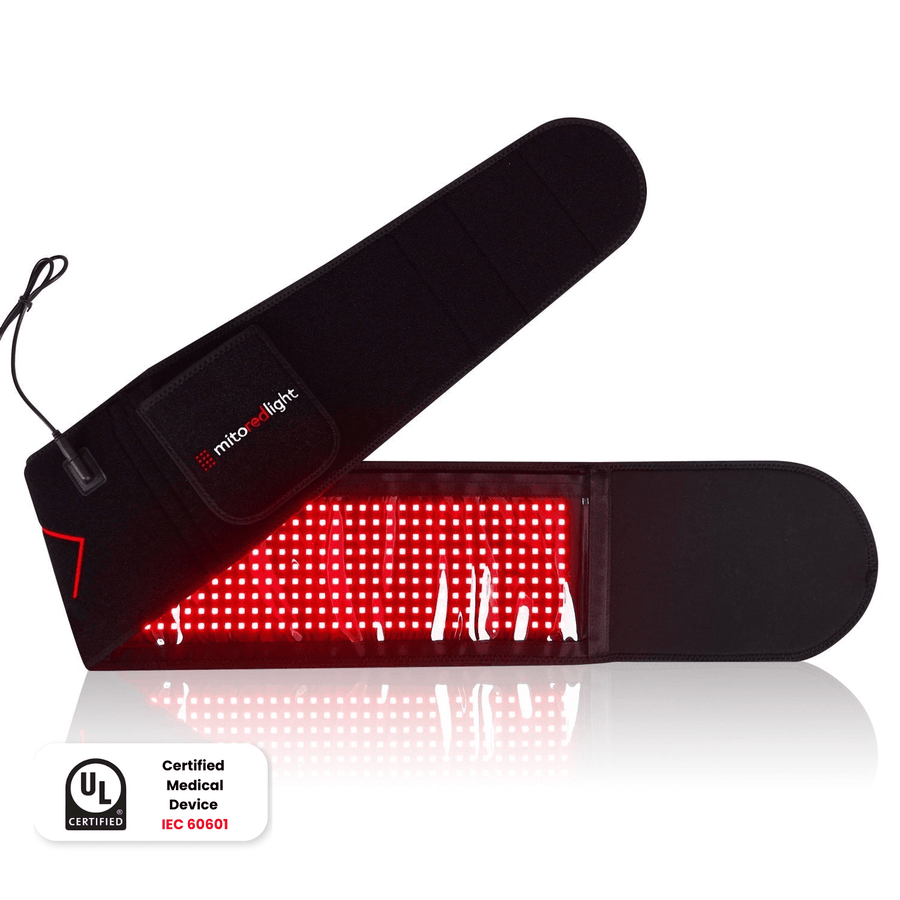
MitoQUAD™ Wavelength Belt
AC-powered model
Wearable red and near-infrared light belt with a focused 22 × 5-inch treatment area.
Shop MitoQUADOfficial Mito Red Light price checked Sep. 3, 2026. Prices can change.Will the MitoQUAD Actually Help My Lower Back Pain?
Maybe for some people, but current research is not strong enough to promise meaningful relief from recurring nonspecific lower-back pain.
A 2016 meta-analysis found short-term pain improvement in some low-level light therapy trials under certain treatment conditions. [2]
A later 2020 systematic review looked at 12 randomized trials involving 1,046 people and found no clinically important improvement in pain or disability compared with sham treatment. [1]
There is another important limitation: these studies looked at photobiomodulation generally, not clinical trials of the MitoQUAD itself. [1]
Do not buy the MitoQUAD expecting it to diagnose or fix the reason your back keeps hurting.
It makes more sense if targeted red/NIR light is something you already want to include in your recovery or wellness routine.
Where the MitoQUAD Makes More Sense Than a Red Light Panel
Its biggest advantage is not the LED count. It is how easily you can keep the light directly around one focused body area.
The MitoQUAD has a roughly 22 × 5-inch treatment area, and Mito positions the belt for focused areas such as the lower back, abdomen, and quadriceps. [3]
For someone mainly interested in their lower back, that format solves a practical problem.
You do not need to stand with your back facing a panel or repeatedly adjust your position just to keep the same area exposed.
But the 22 × 5-Inch Coverage Can Also Become Its Biggest Limitation
The MitoQUAD works well as a focused device. It becomes less convenient once several large body areas enter your routine.
Your lower back may be the reason you are shopping today. Later, you may also want to use red light on your:
- upper back,
- shoulders,
- quadriceps,
- hamstrings,
- or several areas after workouts.
You can move the MitoQUAD between those areas, but its focused treatment window means each area needs to be positioned and treated separately. [3]
That creates the real buying tension: spend less on a targeted belt now, or pay more for broader coverage you may grow into later.
Do the Four MitoQUAD Wavelengths Actually Matter?
They give you useful flexibility, but four wavelengths should not be confused with proof of better back-pain relief.
The MitoQUAD lists four wavelengths:
- 630nm red
- 660nm red
- 810nm near-infrared
- 850nm near-infrared
It can run red light, near-infrared light, or both together, and it includes five intensity settings. [3]
That flexibility is useful because you are getting both red and NIR output in one device.
But the wavelength list should not distract you from the decision that matters more:
Do you need targeted convenience or broader coverage?
Is the $349 MitoQUAD Actually Good Value?
Yes if one targeted body area is what you actually want. The value becomes weaker if you already know you want to cover several larger areas.
The standard AC-powered MitoQUAD is currently priced at $349. [3]
For that price, you are mainly paying for:
- wrap-around positioning,
- a focused 22 × 5-inch treatment area,
- red + near-infrared wavelengths,
- five intensity levels,
- and easier access to areas such as the lower back.
That is a reasonable package if your use stays focused.
The $349 option is the plug-in AC model. Mito also lists an AC + external power-bank configuration at a higher price. [3]
So if being completely untethered matters to you, confirm which configuration you are ordering rather than assuming every MitoQUAD package is cordless.
MitoQUAD vs MitoPRO 750X: Which One Fits Your Actual Use?
Choose the MitoQUAD when one focused area matters most. Choose the MitoPRO 750X when your routine is likely to spread across larger body areas.
The MitoPRO 750X currently costs $749, measures approximately 10 × 23 inches, and Mito positions it for upper- or lower-body use. [4]
| What Matters Most? | MitoQUAD | MitoPRO 750X |
|---|---|---|
| Lower back is my main target | Better fit | More coverage than needed |
| I want a wrap-around device | Winner | No |
| I want several body areas | Needs repositioning | Winner |
| I want broader muscle coverage | Limited | Winner |
| Product price | $349 | $749 |
| Long-term versatility | Targeted | Broader |
If Your Lower Back Is the Only Area You Really Care About
Winner: MitoQUAD. Paying roughly $400 more for broader coverage is difficult to justify if most of that extra treatment area will go unused.
Its lower price and wrap-around format fit a focused lower-back use case better. [3]
If Your Recovery Needs Move Around Your Body
Winner: MitoPRO 750X. Its larger format becomes more useful once your lower back is only one of several areas you want to target.
If you regularly want to cover your thighs, shoulders, upper back, or other larger muscle groups, repeatedly moving a smaller belt becomes less convenient.
Which One Gives You More for Your Money?
It depends on what you will actually use. Cheaper does not automatically mean better value.
For one focused area, the MitoQUAD avoids making you pay for coverage you may never use.
For several areas, the MitoPRO 750X costs more upfront but may make more sense than buying a focused belt and then wanting a larger device later. [4]
MitoQUAD™ Wavelength Belt
Choose this if your lower back is the area you keep coming back to and you want a simpler targeted device.
- Wrap-around wearable format.
- Focused 22 × 5-inch treatment area.
- Red + near-infrared wavelengths.
- Lower upfront price.
- Better fit when one area is your priority.
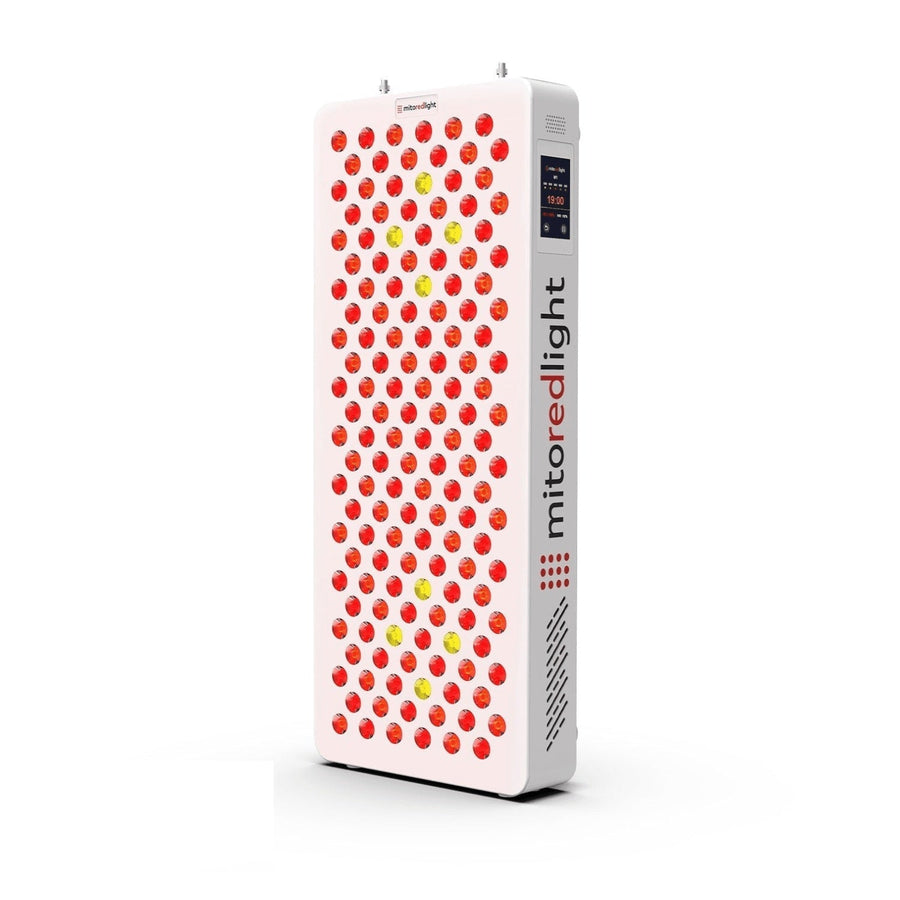
MitoPRO 750X
Choose this if your lower back will not be the only area you want to use red light on.
- Broader upper- or lower-body coverage.
- Better for several muscle groups.
- Less repositioning between areas.
- More versatile for long-term use.
- Better fit if your routine may expand.
What If You Already Know You Want Full-Body Red Light?
Then the MitoQUAD is probably the wrong starting point, and even the 750X may be smaller than what you ultimately want.
Mito positions the MitoPRO 1500X for full-body use. It measures approximately 10 × 43 inches and currently costs $1,299. [4]
That does not make the 1500X a better device specifically for lower-back pain.
It makes more sense only if your real goal is broader: one device for regular full-body use instead of one targeted area.
The Biggest Reason Not to Buy the MitoQUAD
Do not spend $349 because you expect a red-light belt to solve the underlying cause of recurring lower-back pain.
Clinical evidence for photobiomodulation in nonspecific lower-back pain remains mixed, and the later systematic review did not find clinically important improvements in pain or disability. [1]
The MitoQUAD is easier to justify as a convenient targeted red/NIR device than as a promised solution to chronic pain.
Final Verdict: Is the MitoQUAD Worth It?
Yes — if your lower back is your main target and focused convenience matters more to you than broad coverage.
- Your lower back is the main area you expect to use it on.
- You want a wrap-around device rather than standing in front of a panel.
- The $349 price makes more sense for your budget.
- You do not expect to target several large body areas regularly.
- You understand that research does not guarantee pain relief.
- Your shoulders, upper back, thighs, or other muscles are also priorities.
- You want broader coverage with less repositioning.
- You already know your red-light routine will expand beyond one area.
If recurring back pain is severe, unexplained, worsening, or persistent, getting the underlying cause properly evaluated is more important than choosing between a belt and a larger red-light panel.
MitoQUAD™ Wavelength Belt
Wearable 22 × 5-inch treatment area with 630nm, 660nm, 810nm and 850nm wavelengths plus five intensity settings.
Shop MitoQUADStandard AC-powered model. Official Mito Red Light price checked Sep. 3, 2026. Prices can change.MitoQUAD FAQs:
These are the practical questions worth answering before deciding whether the MitoQUAD fits your lower-back routine.
How long should I use the MitoQUAD on my lower back?
Mito recommends approximately 15–20 minutes per session, once or twice daily on the target area. [3]
More time is not automatically better. The belt has five intensity settings, so a sensible approach is to start at a comfortable level and follow the manufacturer’s current instructions rather than extending sessions in an attempt to get faster results.
Should the MitoQUAD be used over clothing or directly on skin?
Mito’s usage guidance is based on the belt being worn directly against the skin. [3]
That is different from a panel, where you normally sit or stand some distance from the light. The belt is designed for close, targeted contact with the treatment area.
If direct contact feels uncomfortable or you have a skin-related concern, follow the current product manual and relevant medical advice rather than simply increasing distance or intensity yourself.
Is the MitoQUAD cordless, or does it have to stay plugged in?
The standard $349 MitoQUAD can be powered from a wall outlet. Mito has also offered a custom power-bank option for cord-free use, but battery availability can change. [3]
So do not assume that “wearable” automatically means cordless. If moving around during a session matters to you, check the current product configuration and power-bank availability before ordering.
How quickly should I expect the MitoQUAD to help my lower back?
There is no reliable guaranteed timeline for lower-back pain relief. Mito says some users may notice changes after several weeks of consistent use, but that is manufacturer guidance rather than proof that the belt will relieve recurring back pain for every buyer. [3]
The clinical evidence discussed earlier in this review is mixed, and the studies were not trials of the MitoQUAD itself. [1]
A better buying expectation is to treat the MitoQUAD as a convenient red/NIR device that may fit your recovery routine — not as a guaranteed fix for the underlying cause of persistent lower-back pain.
Sources & references
- Tomazoni SS, et al. Photobiomodulation therapy and nonspecific low-back pain systematic review. Journal of Physiotherapy, 2020.Open source ↗
- Glazov G, et al. Low-level laser therapy for chronic nonspecific low-back pain meta-analysis, 2016.Open source ↗
- Mito Red Light. MitoQUAD Wavelength Belt product page — price, treatment area, wavelengths, intensity levels and power configurations.Open source ↗
- Mito Red Light. MitoPRO X Series — MitoPRO 750X and MitoPRO 1500X pricing, dimensions and intended coverage.Open source ↗
 ✓
✓