
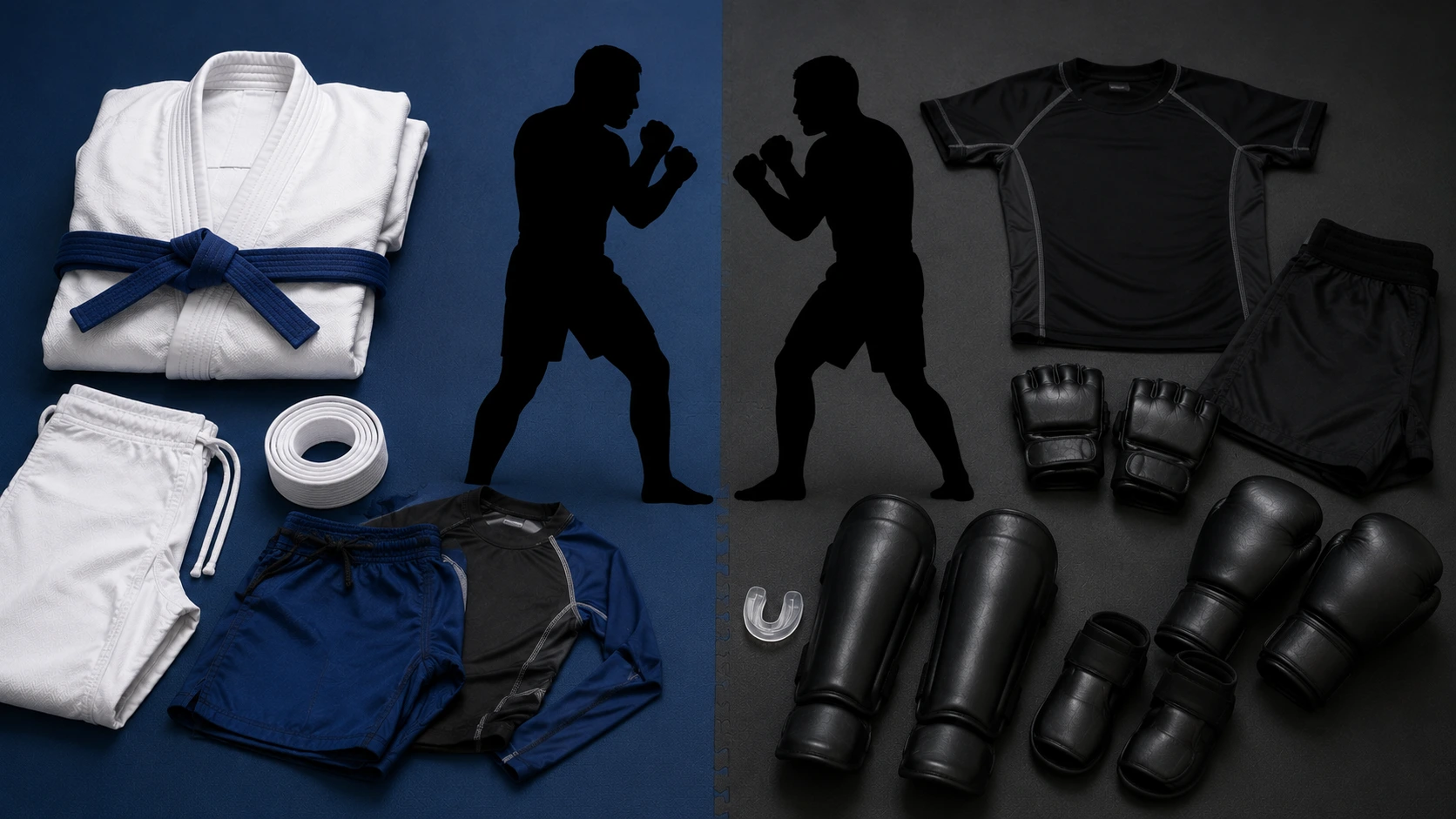

Combat Sports Gear Guide
BJJ and MMA may look similar to beginners because both involve grappling, conditioning, and mat work, but the gear is not the same. This guide explains the difference between BJJ vs MMA gear, what each sport requires, and which combat sports equipment you should buy first.
Last Updated: May 7, 2026
Quick Answer
BJJ gear is mainly designed for grappling, gripping, rolling, and submissions. MMA gear is designed for mixed training that includes striking, grappling, clinch work, takedowns, and sparring. BJJ beginners usually need a BJJ gi, belt, rash guard, grappling shorts, spats, and mouthguard, while MMA beginners usually need MMA gloves, boxing gloves, shin guards, rash guard, shorts, mouthguard, and hand wraps.
TL;DR
- BJJ gear focuses on grappling, submissions, mat hygiene, and grip-based training.
- MMA gear focuses on striking, wrestling, grappling, sparring, and full-body protection.
- You need a gi for many Brazilian Jiu Jitsu classes, but MMA usually does not use a gi.
- MMA beginners need more protective gear because striking is part of regular training.
- BJJ equipment is usually simpler at first: gi, belt, rash guard, shorts, and mouthguard.
- The right choice depends on your class type, gym rules, budget, and training goals.
Table of Contents
BJJ vs MMA Gear: What Is the Main Difference?
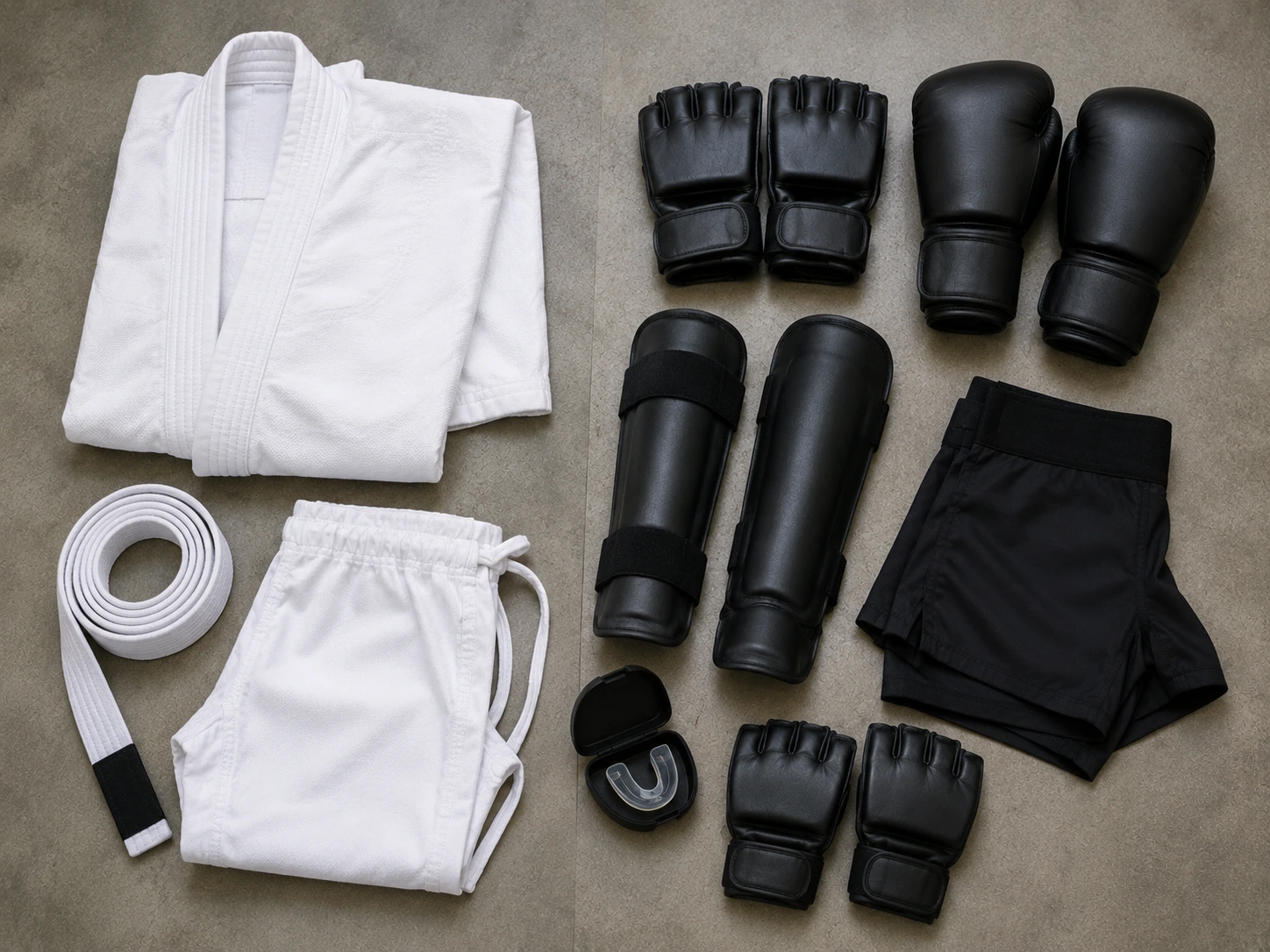
The main difference between BJJ vs MMA gear is purpose. BJJ gear is made for grappling, rolling, submissions, positional control, and grip fighting. MMA gear is made for mixed martial arts training, where athletes may punch, kick, clinch, wrestle, grapple, and spar in the same training week.
Brazilian Jiu Jitsu gear often includes a BJJ gi, belt, rash guard, grappling shorts, spats, and mouthguard. Mixed martial arts gear often includes MMA gloves, boxing gloves, shin guards, mouthguard, rash guard, training shorts, hand wraps, and sometimes headgear or groin protection.
If you are still choosing your first combat sport, start with this broader guide on best martial arts gear for beginners. It explains the basic martial arts equipment new students usually need before training.
Example
A BJJ beginner may spend most of class learning guard, escapes, passing, submissions, and positional control. An MMA beginner may train boxing one day, wrestling another day, kickboxing another day, and grappling later in the week.
Real-World Use
If your class is labeled “BJJ,” you probably need grappling-focused gear. If your class is labeled “MMA,” “striking,” or “sparring,” you will likely need gloves, shin guards, mouthguard, and other protective equipment.
BJJ vs MMA Gear Flatlay
Essential BJJ Gear for Beginners
BJJ gear is designed around grappling. Because Brazilian Jiu Jitsu involves close contact, gripping, friction, mat movement, and submissions, your equipment should be durable, fitted, washable, and comfortable.
1. BJJ Gi
A BJJ gi is a reinforced martial arts uniform used in gi-based Brazilian Jiu Jitsu. It usually includes a jacket, pants, and belt. Compared with many basic martial arts uniforms, a BJJ gi is stronger because opponents grip it during training.
Example: During collar chokes, sleeve grips, guard passing, and takedowns, your gi is pulled repeatedly. A weak uniform may tear or stretch too quickly.
Real-world use: If your academy teaches gi BJJ, buy one properly fitted BJJ gi first instead of buying multiple cheap uniforms.
2. Belt
The belt shows rank in BJJ. Beginners normally start with a white belt. In many cases, the belt comes with the gi, but some gyms prefer specific belt colors, lengths, or academy standards.
Example: A new student should not buy a blue belt, purple belt, or black belt for appearance. Rank is earned through training and promotion.
Real-world use: Ask your coach whether the gi includes a belt or whether you should buy one separately.
3. Rash Guard
A rash guard is a fitted athletic top used under the gi or during no-gi BJJ. It helps reduce skin friction and keeps loose clothing from getting caught during rolling.
Example: A cotton T-shirt may stretch, twist, and hold sweat. A rash guard stays closer to your body and works better for grappling.
Real-world use: Choose a breathable rash guard with flat seams if you train often.
4. Grappling Shorts and Spats
Grappling shorts and spats are common in no-gi BJJ. Shorts should have no sharp zippers, hard buttons, or loose pockets. Spats add coverage and reduce friction on the mat.
Example: No-gi BJJ students often wear a rash guard, grappling shorts, and compression spats for rolling.
Real-world use: Pick shorts that allow hip movement, guard retention, passing, sprawls, and takedowns without riding up.
Essential MMA Gear for Beginners
MMA equipment must support more training types than BJJ equipment. Mixed martial arts gear usually covers striking, grappling, wrestling, clinch work, conditioning, and sparring. Because impact is involved, protective gear matters more from the beginning.
1. MMA Gloves
MMA gloves are open-finger gloves that protect the hands while allowing athletes to grip, clinch, and grapple. They are not the same as boxing gloves.
Example: MMA gloves let you punch lightly during drills while still grabbing wrists, underhooks, or body locks.
Real-world use: Beginners should choose padded training MMA gloves rather than thin competition-style gloves.
2. Boxing Gloves
Many MMA gyms also require boxing gloves for striking drills, bag work, and pad work. Boxing gloves offer more padding than MMA gloves and are better for beginner striking volume.
Example: If you are hitting heavy bags, focus mitts, or Thai pads, boxing gloves usually protect your hands better than small MMA gloves.
Real-world use: Use hand wraps under boxing gloves to support your wrists and knuckles.
3. Shin Guards
Shin guards are essential for kickboxing, Muay Thai, and MMA striking drills. They protect your shins and reduce injury risk for your training partner.
Example: A beginner learning low kicks should wear shin guards during partner practice because timing and control are still developing.
Real-world use: Choose shin guards that stay secure and do not slide around during kicks, checks, and movement.
4. Mouthguard
A mouthguard is important for MMA, sparring, wrestling scrambles, and contact drills. The American Dental Association states that properly fitted mouthguards offer the best available protection for reducing the incidence and severity of sports-related dental injuries. Source: American Dental Association.
Example: Even light sparring can create accidental contact from punches, knees, elbows, head movement, or takedown entries.
Real-world use: Use a mouthguard that fits securely and does not restrict breathing or speech.
BJJ Gi vs MMA Rash Guard: Which One Do You Need?
The BJJ gi and MMA rash guard serve different purposes. A BJJ gi is used for grip-based grappling. A rash guard is used for no-gi grappling, MMA, and sweat-friendly compression training.
BJJ Gi
The gi changes how BJJ works because athletes can grip sleeves, collars, lapels, and pants. This creates techniques that do not exist the same way in MMA or no-gi grappling.
Example: Collar chokes, sleeve grips, lapel guards, and gi-based sweeps require a proper BJJ gi.
Real-world use: Buy a BJJ gi if your academy has gi classes or if your coach says beginners must train in the gi.
MMA Rash Guard
An MMA rash guard is fitted, stretchy, and designed for movement. It works for striking warmups, wrestling drills, grappling, and conditioning.
Example: In MMA, a rash guard is easier to train in than a loose shirt because it does not get grabbed or pulled over your head during grappling.
Real-world use: Buy a rash guard if you train no-gi BJJ, MMA, grappling, or any high-sweat mat class.
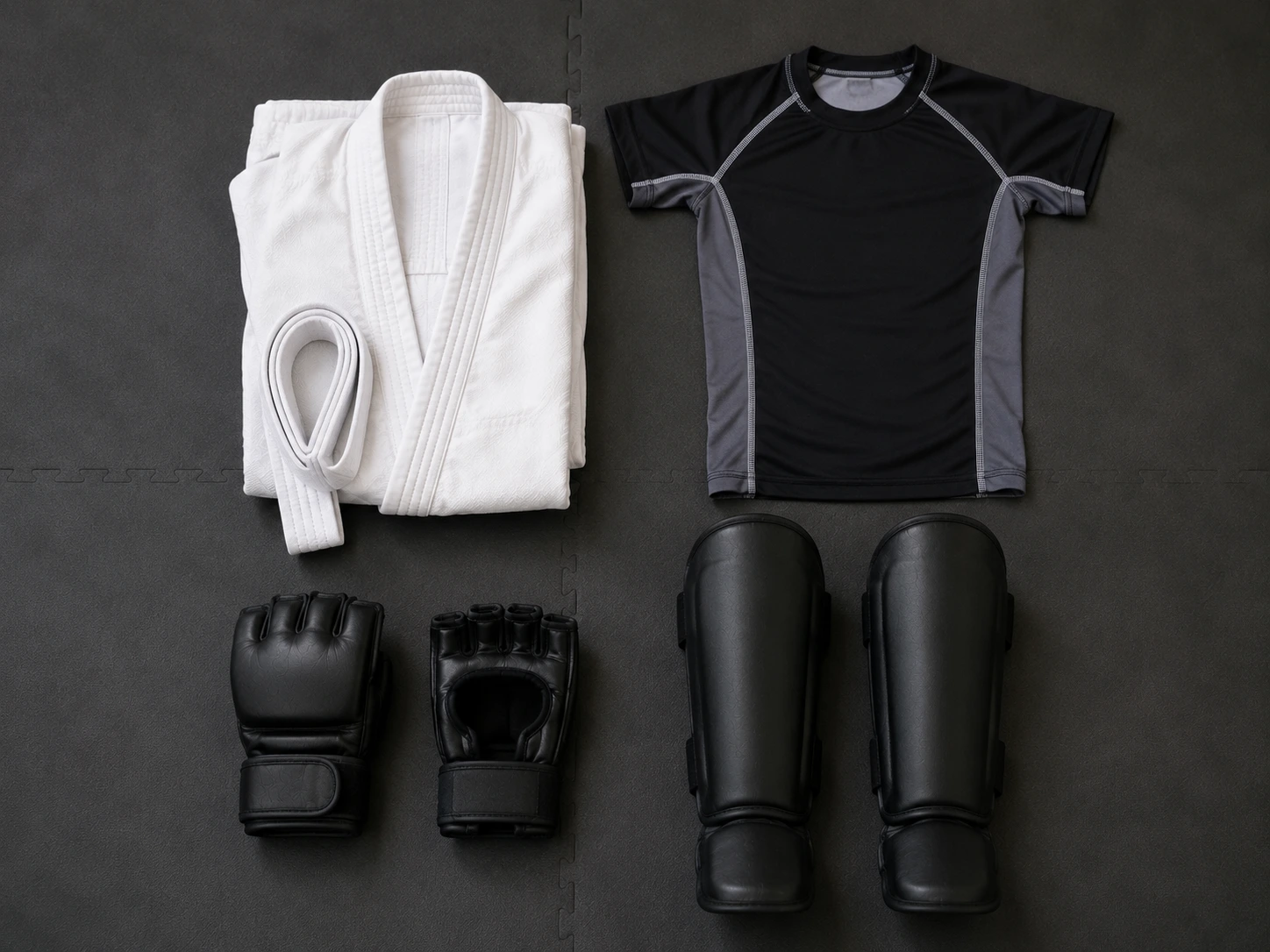
Gi, Rash Guard, Gloves, and Shin Guards Comparison
MMA Gloves vs BJJ Gloves: Do You Need Gloves for BJJ?
Most BJJ students do not need gloves. BJJ is primarily a grappling art, so gloves can interfere with grips, frames, submissions, and hand positioning. MMA gloves are designed for mixed training where striking and grappling happen together.
MMA Gloves
MMA gloves are useful when your class includes punching, clinch striking, wall work, or MMA-specific sparring. They allow more grip than boxing gloves but offer less padding.
Example: During MMA drilling, you may use gloves while practicing jab-to-takedown entries or ground-and-pound positioning.
Real-world use: Use MMA gloves only when your coach says the session requires them.
BJJ and Gloves
Traditional BJJ does not use gloves. Some athletes use finger tape for support, but gloves are not standard BJJ equipment.
Example: If you are practicing guard passing or submissions, gloves may block important grips and hand placement.
Real-world use: For BJJ, spend your money on a good gi, rash guard, grappling shorts, and mouthguard before worrying about gloves.
Protective Combat Sports Gear: BJJ vs MMA
Protective needs are different in BJJ and MMA. BJJ has close contact and joint-control risk, but MMA adds punches, kicks, knees, elbows, and striking exchanges. That means MMA beginners usually need more protective equipment.
Johns Hopkins Medicine notes that proper precautions and protective equipment such as padding, shoes, and mouth guards can help improve safety in sports. Source: Johns Hopkins Medicine.
BJJ Protective Gear
BJJ beginners may need a mouthguard, finger tape, knee sleeves, and sometimes ear protection. Most of these are optional at first unless your coach recommends them.
Example: A mouthguard can be useful in BJJ because accidental knees, elbows, or head contact can happen during rolling.
Real-world use: Start with a mouthguard and add knee sleeves or tape only if your training volume or body needs it.
MMA Protective Gear
MMA beginners often need mouthguard, shin guards, gloves, wraps, groin protection, and sometimes headgear. This is because striking and impact are built into training.
Example: During beginner kickboxing or MMA sparring, shin guards protect both you and your partner while you learn control.
Real-world use: Do not spar without the protective gear your coach requires.
What to Wear to BJJ Class vs MMA Class
What you wear depends on the class format. A gi BJJ class, no-gi BJJ class, MMA class, and striking class may all have different requirements.
What to Wear to BJJ Class
For gi BJJ, wear a BJJ gi, belt, and rash guard underneath if preferred. For no-gi BJJ, wear a rash guard, grappling shorts, and spats if needed.
Example: A new BJJ student attending gi class should not show up in MMA shorts only unless the academy allows it for trial classes.
Real-world use: Bring slides or flip-flops so you are not walking barefoot off the mat.
What to Wear to MMA Class
For MMA class, wear a rash guard or fitted athletic top, flexible training shorts, mouthguard, and the protective gear required for that session.
Example: A beginner MMA class may require boxing gloves for pad work and shin guards for kickboxing drills.
Real-world use: Bring both boxing gloves and MMA gloves if your gym schedule includes striking and mixed drills.
Comparison Table: BJJ Equipment vs MMA Equipment
Buyer Decision Guide: Which Combat Sports Gear Should Beginners Buy?
Use this checklist before buying BJJ equipment or MMA equipment:
- Confirm whether your class is BJJ, no-gi BJJ, MMA, kickboxing, or mixed training.
- Ask your coach what gear is required before buying anything expensive.
- Buy a BJJ gi only if your academy has gi classes.
- Buy MMA gloves only if your class includes MMA-specific striking or mixed drills.
- Buy boxing gloves if your gym includes bag work, pad work, or boxing rounds.
- Buy shin guards if your training includes kicks, checking kicks, or partner striking.
- Buy a mouthguard early for both BJJ rolling and MMA sparring.
- Avoid loose clothing, zippers, pockets, and hard accessories on the mat.
- Choose washable, breathable gear because combat sports create heavy sweat.
- Start with essentials, then upgrade after you know your training schedule.
Common Mistakes When Buying BJJ or MMA Gear
1. Buying MMA Gear for BJJ Class
BJJ beginners often do not need MMA gloves, shin guards, or boxing gloves. If your class is only Brazilian Jiu Jitsu, start with grappling gear first.
2. Buying a Cheap Gi That Shrinks Badly
A low-quality BJJ gi may shrink, tear, or feel uncomfortable during rolling. Fit, weave, stitching, and durability matter. If you also want to compare a real combat sports brand before buying training gear, read this Fuji Sports review for a closer look at gear quality, value, and beginner suitability.
3. Using Boxing Gloves Instead of MMA Gloves
Boxing gloves are not designed for grappling. MMA gloves are used when striking and gripping are both part of the session.
4. Skipping the Mouthguard
Many beginners delay buying a mouthguard, but accidental contact can happen in both BJJ and MMA.
5. Buying Competition Gear Too Early
Beginners do not need advanced competition gear on day one. Buy basic training gear first and upgrade once you know your sport and gym rules.
Expert Insight
The cleanest way to understand BJJ vs MMA gear is this: BJJ gear is built for grappling control, while MMA gear is built for mixed combat training. BJJ students need equipment that supports rolling, gripping, and mat hygiene. MMA students need equipment that protects the hands, shins, mouth, and body during striking and grappling.
For beginners, the best strategy is not to buy the biggest gear bundle. Start with the exact gear your academy requires, train consistently for a few weeks, then upgrade based on your actual classes.
For more lifestyle, fashion, and activewear buying guides, explore PromoLatte’s lifestyle hub, the fashion section, and the apparel and clothing category.
Trusted Sources Behind This Guide
This guide uses broader safety, fitness, and sports protection context from trusted sources:
- American Dental Association — athletic mouthguards and dental injury prevention.
- Johns Hopkins Medicine — sports injury prevention and protective equipment.
- Mayo Clinic News Network — proper equipment and sports injury prevention.
- Cleveland Clinic — boxing workout benefits including coordination, endurance, and full-body strength.
FAQs About BJJ vs MMA Gear
What is the difference between BJJ and MMA gear?
BJJ gear is mainly for grappling, submissions, and mat work. MMA gear is for mixed training that includes striking, wrestling, grappling, clinch work, and sparring.
What gear do you need for BJJ?
For BJJ, beginners usually need a BJJ gi, belt, rash guard, grappling shorts, spats, mouthguard, and slides for walking off the mat. No-gi BJJ usually requires rash guard and grappling shorts instead of a gi.
What gear do you need for MMA?
For MMA, beginners usually need MMA gloves, boxing gloves, shin guards, mouthguard, hand wraps, rash guard, flexible shorts, and sometimes groin protection or headgear depending on the class.
Do you need a gi for BJJ or MMA?
You often need a gi for traditional BJJ classes. MMA usually does not use a gi because mixed martial arts training is based on striking, wrestling, clinch work, and no-gi grappling.
Can I use MMA gear for BJJ?
You can use some MMA gear for no-gi BJJ, such as a rash guard and grappling shorts. However, MMA gloves, shin guards, and boxing gloves are not normally used in regular BJJ classes.
Are MMA gloves the same as BJJ gloves?
No. MMA gloves are made for mixed striking and grappling. BJJ does not normally use gloves because grips, frames, and hand placement are central to training.
What should I wear to my first BJJ class?
For gi BJJ, wear a BJJ gi and belt if required. For no-gi BJJ, wear a rash guard and grappling shorts. For a trial class, clean fitted athletic clothing may be allowed, but ask the gym first.
What should I wear to my first MMA class?
For MMA, wear a rash guard or fitted athletic top, flexible shorts, and bring a mouthguard. Your gym may also require boxing gloves, MMA gloves, hand wraps, or shin guards depending on the session.
Conclusion
BJJ and MMA gear are different because the sports are different. BJJ gear is built for grappling, rolling, gripping, and submissions. MMA gear is built for a wider training style that includes striking, wrestling, clinch work, grappling, and sparring.
If you are starting Brazilian Jiu Jitsu, focus on a BJJ gi, belt, rash guard, grappling shorts, spats, and mouthguard. If you are starting MMA, prioritize MMA gloves, boxing gloves, shin guards, mouthguard, hand wraps, rash guard, and flexible shorts.
Your best move is simple: choose gear based on your actual class, not what looks impressive online. Ask your coach, buy the essentials first, and upgrade once you know whether you are training BJJ, MMA, or both. For more beginner-friendly buying guides, visit PromoLatte.
 ✓
✓